Monday, October 24, 2011

On folklore


It is common practice with any group to see stories swell in their scope with every telling. Facts become blurred, and certain truths are lost. The “fish” gets bigger the longer it's been since it got away. This happens for several reasons, not the least of which is the way our memory works so that only those things that most strongly impact us are held strongly in our minds while everything else becomes blurred. As a result things that felt huge at the time become ever larger in our minds as time goes by.
This mental phenomenon is only one part of the change in stories. The other is the so called “poetic license”. Storytellers need to enrapture their audience one way or another, and a very simple and effective method is to make things viscerally powerful. Things that are larger than life jump out at us and capture our attention. We all wish we could be the mighty hero who overcomes incredible (often impossible) odds, going far beyond the limits of ordinary humans (and well beyond the laws of the natural world). Thus a brave man who performs a bold act slowly becomes a superhuman warrior of legendary feats, a hero immortalized for many generations to come.
Lastly, over time, we hear the same story so often that we become accustomed to the bold act, becoming desensitized to how amazing it truly was. Like a junkie who needs increasingly higher dosages, the deed needs to become greater with each telling in order for the audience to continue to be impressed. As a result stories and feat become ever greater in a constant exercise of “one-up-manship”, a perfect example of which is Monty Python's skit about a group of older gentlemen who complain about the ungrateful nature of the younger generation who don't appreciate how much easier their lives are as opposed to the difficult childhood each of these men experienced. They then take turns telling how horribly difficult their lives were, each one worse than the last. Things quickly go to ridiculous extremes, with the gentlemen claiming their entire 20 member families lived in a shoebox in a whole in the road, worked 36 hours each day at the nearby mill, without food, then returned home and were killed by their father before going to bed each night.
Cultural tales of heroism suffer from these same phenomenon, doubly so the stories of mythical martial artists of the past. As I mentioned earlier this comes at the cost of losing important an important truth, since the feat has been blown so completely out of proportion we can't really know what the true original feat was. Without a realistic measure of what happened we can't know what truly happened, and therefore we can't gauge how truly great the ancient deed truly was in comparison to our own efforts.
However not all truth is lost. The dramatics and theatrics that obscure the realism of the tale also work to highlight lessons and teachings. The oral stories and traditions should not be blindly accepted as factual truth, but rather as moral stories. They can highlight important messages and teachings. They may simultaneously preserve and obscure unexpected applications of certain movements or techniques. They preserve an ideal (and therefore impossible) goal for the individual practitioner and the art as a whole, which functions as the carrot on a stick that helps them continuously move forward and evolve, always striving to improve.
Therefore listen to the stories, to the myths and legends. Hear them carefully and with a critical eye and you will find nuggets of wisdom and great lessons. In this way they become more than blindly believed tales, they becomes lessons to help us learn to analyze and be critical thinkers rather than to be indoctrinated fools. Listen and be mindful, open your heart, your ears and your mind; if you do you'll find that the tales become truly do become more amazing with each telling, teaching us more each time.

Wednesday, October 12, 2011

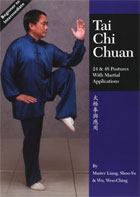
Tai Chi Chuan- 24 & 48 Postures With Martial Applications - Book Review


Tai Chi Chuan- 24 & 48 Postures With Martial Applications
by Master Liang, Shou-Yu & Wu, Wen-Ching

As part of our efforts to revitalize the blog I'll begin periodically recommending some helpful books. To begin I've chosen one of the first Tai Chi books I read. This book by Master Liang is a great reference tool and is especially helpful for beginners who want to perfect their stances and get a basic idea of some of the applications for the form movements.

Initially the book gives a brief, overall description of Tai Chi theory. It covers basic breathing methods and includes several illustrations of some basic energy channels and accupoints. It then goes on to give a brief history of the art and its development. It then goes on to give some basic guidelines for practitioners to follow. They're very general pointers that mostly echo the Eight Body Methods and the Song of the Thirteen Postures, but a reminder is never a bad thing.

After this the author gives detailed explanations of the many body postures employed in Tai Chi's forms including several photographs to help students get a full understanding of how to adopt the posture, and then how to transition from one posture to the another. This is easily one of the most valuable parts of the book since one of the most important (and most difficult to grasp) parts of Tai Chi are the transitions between the postures. Transitions between postures are never easy to display and are especially difficult to show in a book. That said the author does an admirable job in giving detailed written explanations of how to execute said transitions.

Lastly, the book offers some basic applications for the movements in the 24 form. The transitions have fewer pictures and the applications are very basic, but for beginners it helps to offer them some simple examples of what they can do. Sadly Tai Chi Chuan is rarely taught with any emphasis on its martial aspects. This is a major problem not only in that it greatly reduces depth to which the student can learn, but it also castrates the form, making it impossible for students to learn how to defend themselves. While some students (and sadly many teachers) are willing to forego any knowledge as to the arts martial aspects they fail to appreciate how detrimental this lack of knowledge is to the performance of the form. Knowing the applications that the movements are designed to execute is precisely what dictates how the movement must be performed during form practice. Without this knowledge the movements will invariably be clumsy, incomplete and possibly detrimental.

I've personally borne witness to instructors who've practiced the form for years without ever developing any knowledge as to the applications those movements are designed for. As a result they tend to have problems establishing a firm root and correct body alignment. When they and their students perform the movements incorrectly they torque their knees, wobble on misaligned hips and ankles, have poorly distributed weight causing them to be unbalanced (and sometimes fall), etc. In essence their lack of understanding results in incorrect movements that harm rather than help the practitioners. For this reason alone this (albeit brief) portion of the book alone makes it a very worthwhile read, especially for beginners.

In summary it's a great read. It offers the beginner a good introduction to several aspects of the art and it offers more advanced practitioners a quick reference to some of the basic aspects and movements of the art.

Saturday, September 17, 2011

Team Championship Cup


I was very happy when in 2006 I became part of the Puertorican team that went to Zheng Zhou, China to compete in the 2nd World Traditional Wushu Championship. The entire trip is full of very fond memories that I will forever cherish, both on and off of the competition floor.

As for the Championship itself it consisted of a week's worth of events and activities culminating in the team choreography events. Our team had done fairly well during the individual events, taking several bronze, silver and even a few gold medals. (I was very honored to receive silver in hand forms and bronze in weapons forms.) At last it was time for the final event and all the different teams gathered together to perform their routines before an unexpected group of guest judges including Wu Bing and Li Deiyin.

This really put all of the teams on their toes and us in particular as the routine our team would be performing was one created by Master Li Deiyin, the well known Tai Chi Kung Fu fan routine. Despite having a major musical malfunction (the sound system died halfway through our routine) we didn't miss a beat. What was truly amazing was that the crowd was so exited that they started singing and clapping their hands to the beat to cover the silence when the music died! Hearing the whole stadium singing and clapping was truly amazing. We were exceptionally pleased with how things went and incredibly shocked when were told we'd one. Then the camera crews came over and everything after was very much a blur, but it truly was magical. It was an experience I'll treasure for the rest of my life.